Dry Sage (#bcb88a) Color Meaning, Codes and Information
A complete guide to Dry Sage (#bcb88a) covering color values, harmonies, shades, meaning, and practical uses across design, branding, and everyday visuals.
A complete guide to Dry Sage (#bcb88a) covering color values, harmonies, shades, meaning, and practical uses across design, branding, and everyday visuals.
Dry Sage (#BCB88A) is a balanced yellow color. It features RGB values of (188, 184, 138), HSL settings of (55°, 27%, 64%), and a CMYK profile of (0%, 2%, 27%, 26%). Flanked by Neon Carrot (#FFA343) and Light Brown (#C4A484), this shade provides a distinct alternative within its hue family. Compared to Purple Mountains Majesty (#9D81BA), #BCB88A appears richer, giving it a deeper and more authoritative appearance.
Harmonious matches include Light Brown (#C4A484), Laurel Green (#A9BA9D), and Pastel Turquoise (#7FB5B5), creating a balanced aesthetic, while colors like African Violet (#B284BE), or Gray-Blue (#8C92AC) may clash with it due to differing tones. Designers often use #BCB88A in branding, environmental graphics, and design systems where a specific visual weight is required.
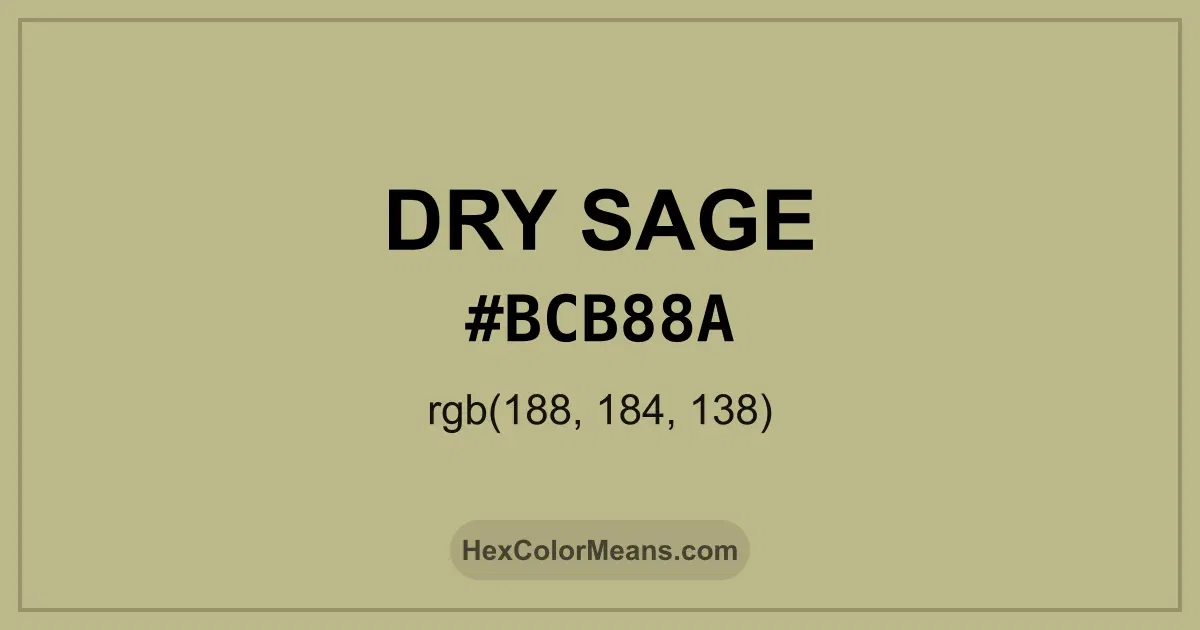
Dry Sage (#BCB88A) is a soft green with beige undertones. It belongs to desaturated herbal greens shaped by arid climates. The shade feels calm and airy. Dry Sage (#BCB88A) avoids visual weight. Symbolism linked to Dry Sage (#BCB88A) includes moderation, wisdom, and quiet awareness. It suggests reflection over reaction. The color supports mental clarity. Dry Sage (#BCB88A) feels composed and gentle. In Mediterranean regions, sage plants carried meaning tied to longevity and care. Similar hues appeared in stone homes and woven textiles. The color mirrored dry hillsides. Dry Sage (#BCB88A) continues to reflect measured living.
Accurate conversions of Dry Sage (#bcb88a) across RGB, Hex, CMYK, HSL, and Lab ensure consistent color fidelity across digital, print, and design applications.
Detailed RGB and CMYK values of Dry Sage (#bcb88a) displayed in a horizontal bar provide clear reference for digital and print color accuracy.
A full range of Dry Sage (#bcb88a) variations, including tints, shades, and tones, provides highlights, depth, and subtle desaturated options for UI design.
Harmonious color schemes for Dry Sage (#bcb88a) created using the color wheel ensure visually balanced palettes.
Colors adjacent on the color wheel (30° apart)
Colors opposite on the color wheel (180° apart)
Three colors using one base hue and the two hues beside its opposite
Three colors evenly spaced (120° apart)
Four colors forming a rectangle on the wheel
Four colors evenly spaced (90° apart)
Four colors formed from two base hues and the colors next to their opposites
Variations of a single hue
Luminance contrast ratios for Dry Sage (#bcb88a) against standard backgrounds ensure readable, accessible text following Contrast Checker and WCAG 2.1 AA/AAA standards.
Sample Text
This is how your text will look with these colors.
Simulated views of Dry Sage (#bcb88a) for different color vision deficiencies help identify potential confusion using the Color Blindness Simulator.
Note: These simulations are approximations. Actual color vision deficiency varies by individual.
Sample Text
Sample Text
High-resolution seamless patterns featuring Dry Sage (#bcb88a) provide ready-to-use backgrounds, wallpapers, and print designs for any project.
A collection of popular icons in Dry Sage (#bcb88a) offers ready-to-use visuals for interfaces, designs, and creative projects.
Real-world mockups of Dry Sage (#bcb88a) showcase its versatility across fashion, interiors, branding, and product packaging.
A curated set of tools to help apply, analyze, and manage colors effectively in your projects
Frequently asked questions about Dry Sage (#bcb88a) color meaning, symbolism, and applications. Click on any question to expand detailed answers.