Smoke (#848884) Color Meaning, Codes and Information
A complete guide to Smoke (#848884) covering color values, harmonies, shades, meaning, and practical uses across design, branding, and everyday visuals.
A complete guide to Smoke (#848884) covering color values, harmonies, shades, meaning, and practical uses across design, branding, and everyday visuals.
Smoke (#848884) is a subtle neutral color. Technical specifications include RGB (132, 136, 132), HSL (120°, 2%, 53%), and CMYK (3%, 0%, 3%, 47%). Positioned between Clover (#00FF6F) and UFO Green (#3CD070), it offers a distinct transition in the chromatic sequence. When viewed beside Titanium (#888688), #848884 displays a deeper quality due to its unique composition.
This color pairs well with Titanium (#888688), and Taupe Gray (#8B8589), producing visually striking combinations, while opposing hues may create strong visual tension. This color is suitable for branding, environmental graphics, and design systems, often utilized to create a distinct atmosphere.
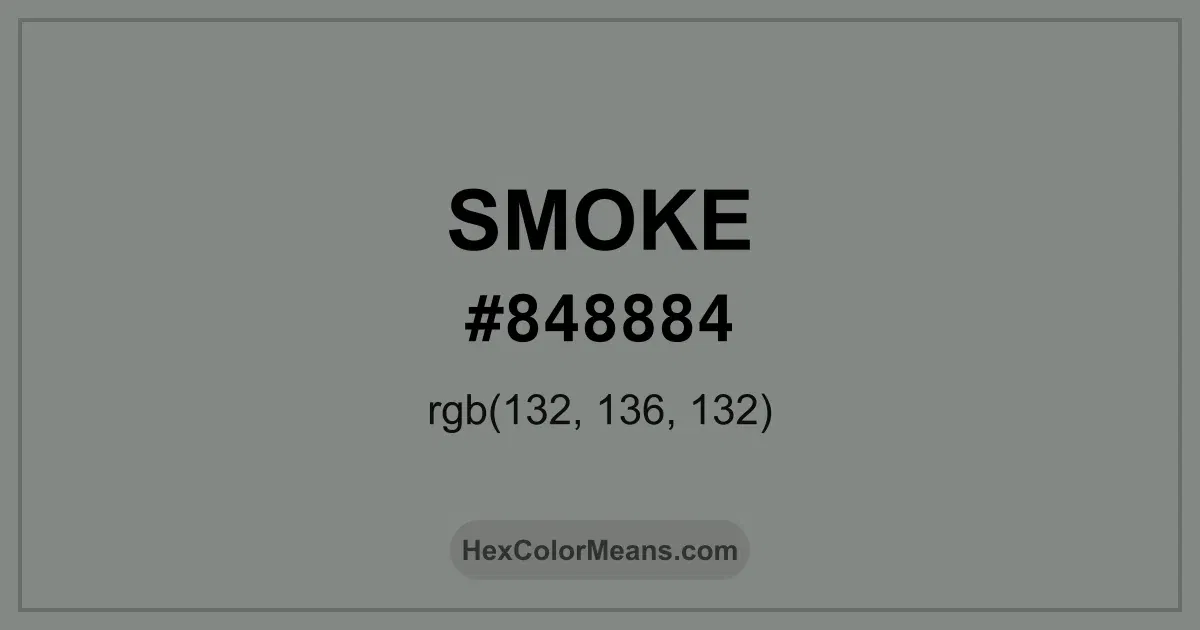
Smoke (#848884) is a muted gray with subtle hints of blue and green. It belongs to the neutral color family, often considered a middle ground between black and white. Its subdued shade gives it versatility in design and fashion. This color evokes a sense of calmness and balance, making it suitable for backgrounds or minimalistic palettes. In interiors, smoke brings sophistication without drawing attention. Historically, smoke (#848884) has been associated with industrial landscapes and modern architecture. During the 20th century, it became a symbol of urban living, reflecting steel, concrete, and fog-filled cityscapes. Its muted tone contrasts sharply with vivid colors, providing a grounding effect. In art, smoke is used to suggest mystery or subtle transitions between light and shadow. Smoke (#848884) carries symbolic meanings of neutrality and detachment. In some Asian cultures, gray shades signify humility and restraint. In Western symbolism, it can represent compromise or aging. Its psychological influence is calming but can also suggest melancholy if overused. Interestingly, smoke is often paired with green or warm tones to soften its starkness, creating harmony in design.
Accurate conversions of Smoke (#848884) across RGB, Hex, CMYK, HSL, and Lab ensure consistent color fidelity across digital, print, and design applications.
Detailed RGB and CMYK values of Smoke (#848884) displayed in a horizontal bar provide clear reference for digital and print color accuracy.
A full range of Smoke (#848884) variations, including tints, shades, and tones, provides highlights, depth, and subtle desaturated options for UI design.
Harmonious color schemes for Smoke (#848884) created using the color wheel ensure visually balanced palettes.
Colors adjacent on the color wheel (30° apart)
Colors opposite on the color wheel (180° apart)
Three colors using one base hue and the two hues beside its opposite
Three colors evenly spaced (120° apart)
Four colors forming a rectangle on the wheel
Four colors evenly spaced (90° apart)
Four colors formed from two base hues and the colors next to their opposites
Variations of a single hue
Luminance contrast ratios for Smoke (#848884) against standard backgrounds ensure readable, accessible text following Contrast Checker and WCAG 2.1 AA/AAA standards.
Sample Text
This is how your text will look with these colors.
Simulated views of Smoke (#848884) for different color vision deficiencies help identify potential confusion using the Color Blindness Simulator.
Note: These simulations are approximations. Actual color vision deficiency varies by individual.
Sample Text
Sample Text
High-resolution seamless patterns featuring Smoke (#848884) provide ready-to-use backgrounds, wallpapers, and print designs for any project.
A collection of popular icons in Smoke (#848884) offers ready-to-use visuals for interfaces, designs, and creative projects.
Real-world mockups of Smoke (#848884) showcase its versatility across fashion, interiors, branding, and product packaging.
A curated set of tools to help apply, analyze, and manage colors effectively in your projects
Frequently asked questions about Smoke (#848884) color meaning, symbolism, and applications. Click on any question to expand detailed answers.