
Mantis (#74c365) Color Meaning, Codes and Information
A complete guide to Mantis (#74c365) covering color values, harmonies, shades, meaning, and practical uses across design, branding, and everyday visuals.
A complete guide to Mantis (#74c365) covering color values, harmonies, shades, meaning, and practical uses across design, branding, and everyday visuals.
Mantis (#74C365) is a balanced green color. It features RGB values of (116, 195, 101), HSL settings of (110°, 44%, 58%), and a CMYK profile of (41%, 0%, 48%, 24%). Positioned between Traffic Grey A (#8D948D) and Signal Grey (#969992), it offers a distinct transition in the chromatic sequence. Compared to Super Pink (#CF6BA9), #74C365 appears deeper, giving it a deeper and more authoritative appearance.
For complementary designs, combine it with Olivine (#9AB973), Emerald (#50C878), and Toolbox (#746CC0) to achieve a cohesive look, while colors like Fuzzy Wuzzy (#CC6666), or Rich Lilac (#B666D2) may contrast sharply with it due to differing tones. Designers often use #74C365 in branding, environmental graphics, and design systems where a specific visual weight is required.
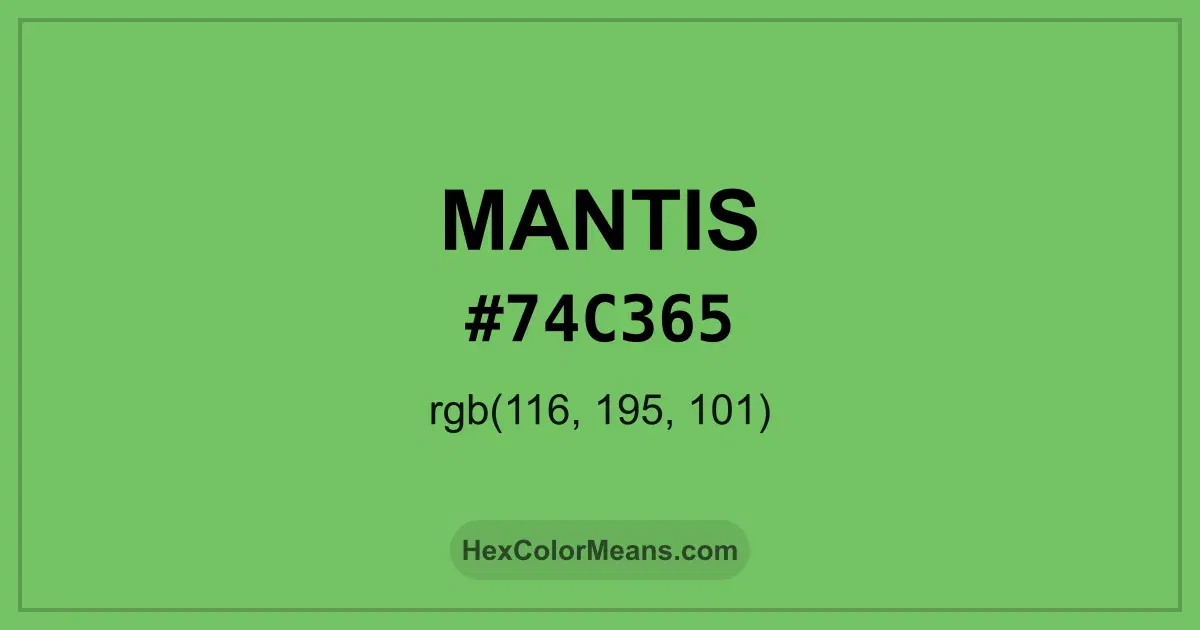
Mantis (#74C365) is a fresh, mid-tone green that leans toward a natural leafy hue. It is a lively green, symbolizing growth, balance, and renewal. Its moderate vibrancy allows it to convey life without overwhelming other colors. Mantis (#74C365) has symbolic ties to nature, plants, and springtime renewal. It often appears in horticultural branding, wellness spaces, and eco-friendly design. The color is reminiscent of lush vegetation and sustainable living, emphasizing harmony with the natural environment. In spiritual and cultural contexts, Mantis (#74C365) encourages healing, patience, and growth. Associated with the heart chakra, it promotes empathy, compassion, and connection. Across world cultures, green tones like Mantis are linked to prosperity, fertility, and freshness, often appearing in rituals, art, and traditional garments where life and balance are celebrated.
Accurate conversions of Mantis (#74c365) across RGB, Hex, CMYK, HSL, and Lab ensure consistent color fidelity across digital, print, and design applications.
Detailed RGB and CMYK values of Mantis (#74c365) displayed in a horizontal bar provide clear reference for digital and print color accuracy.
A full range of Mantis (#74c365) variations, including tints, shades, and tones, provides highlights, depth, and subtle desaturated options for UI design.
Harmonious color schemes for Mantis (#74c365) created using the color wheel ensure visually balanced palettes.
Colors adjacent on the color wheel (30° apart)
Colors opposite on the color wheel (180° apart)
Three colors using one base hue and the two hues beside its opposite
Three colors evenly spaced (120° apart)
Four colors forming a rectangle on the wheel
Four colors evenly spaced (90° apart)
Four colors formed from two base hues and the colors next to their opposites
Variations of a single hue
Luminance contrast ratios for Mantis (#74c365) against standard backgrounds ensure readable, accessible text following Contrast Checker and WCAG 2.1 AA/AAA standards.
Sample Text
This is how your text will look with these colors.
Simulated views of Mantis (#74c365) for different color vision deficiencies help identify potential confusion using the Color Blindness Simulator.
Note: These simulations are approximations. Actual color vision deficiency varies by individual.
Sample Text
Sample Text
High-resolution seamless patterns featuring Mantis (#74c365) provide ready-to-use backgrounds, wallpapers, and print designs for any project.
A collection of popular icons in Mantis (#74c365) offers ready-to-use visuals for interfaces, designs, and creative projects.
Real-world mockups of Mantis (#74c365) showcase its versatility across fashion, interiors, branding, and product packaging.
A curated set of tools to help apply, analyze, and manage colors effectively in your projects
Frequently asked questions about Mantis (#74c365) color meaning, symbolism, and applications. Click on any question to expand detailed answers.