Wenge (#645452) Color Meaning, Codes and Information
A complete guide to Wenge (#645452) covering color values, harmonies, shades, meaning, and practical uses across design, branding, and everyday visuals.
A complete guide to Wenge (#645452) covering color values, harmonies, shades, meaning, and practical uses across design, branding, and everyday visuals.
Wenge (#645452) is defined as a subtle red. Technical specifications include RGB (100, 84, 82), HSL (7°, 10%, 36%), and CMYK (0%, 16%, 18%, 61%). In the color spectrum, it sits between Grussrel (#B06500) and Beige Brown (#79553D), bridging the gap with its distinct tone. Against Stormcloud (#4F666A), #645452 leans deeper, marked by its distinct tonal shift.
For complementary designs, combine it with Stormcloud (#4F666A) to achieve a cohesive look; however, shades such as Ebony (#555D50), or Independence (#4C516D) tend to discord with it, creating visual tension. In professional settings, #645452 is frequently applied in branding, environmental graphics, and design systems.
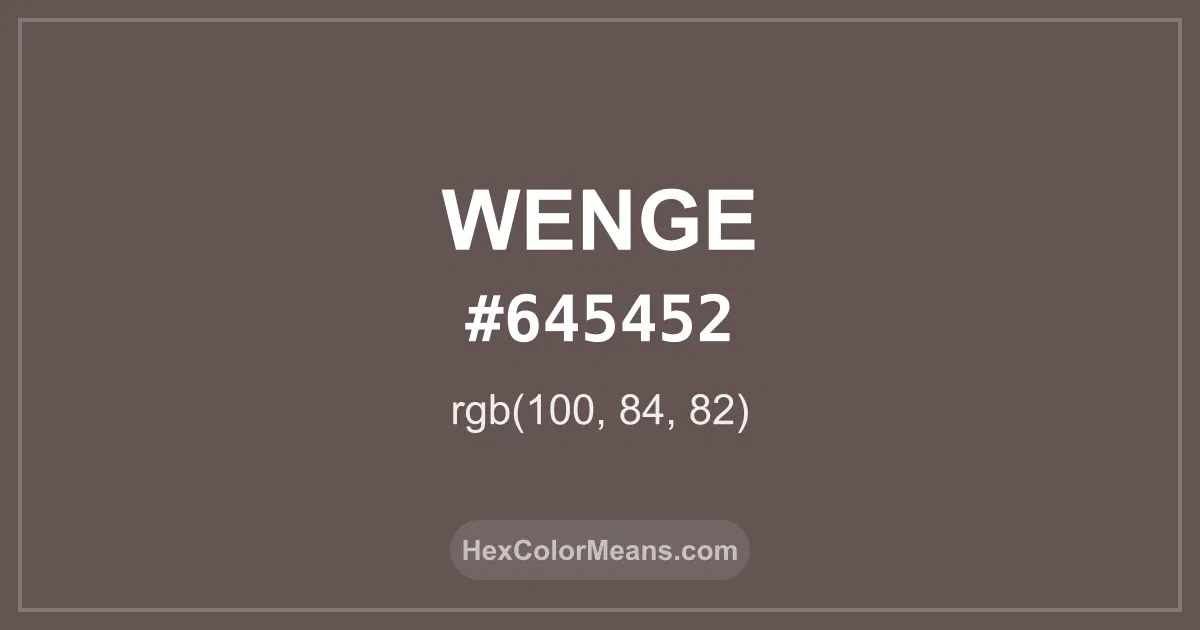
Wenge (#645452) is a dark, muted brown with slight purple-gray undertones, resembling the wood of the wenge tree native to Africa. Its deep tone conveys elegance, durability, and sophistication. Wenge (#645452) is extensively used in furniture, interiors, and high-end design to communicate richness and timelessness. The color embodies strength, refinement, and grounding. Wenge (#645452) anchors visual compositions and contrasts beautifully with lighter, warmer hues. Its subtle undertones add complexity, making it more than a standard brown while remaining versatile in design. Pigments for Wenge (#645452) can be replicated using iron oxide blends and organic dyes to achieve its muted depth. In African cultures, wenge wood is prized for its density, beauty, and longevity, reflecting protection and status. Wenge (#645452) blends natural inspiration with sophistication, creating a luxurious and meaningful shade.
Accurate conversions of Wenge (#645452) across RGB, Hex, CMYK, HSL, and Lab ensure consistent color fidelity across digital, print, and design applications.
Detailed RGB and CMYK values of Wenge (#645452) displayed in a horizontal bar provide clear reference for digital and print color accuracy.
A full range of Wenge (#645452) variations, including tints, shades, and tones, provides highlights, depth, and subtle desaturated options for UI design.
Harmonious color schemes for Wenge (#645452) created using the color wheel ensure visually balanced palettes.
Colors adjacent on the color wheel (30° apart)
Colors opposite on the color wheel (180° apart)
Three colors using one base hue and the two hues beside its opposite
Three colors evenly spaced (120° apart)
Four colors forming a rectangle on the wheel
Four colors evenly spaced (90° apart)
Four colors formed from two base hues and the colors next to their opposites
Variations of a single hue
Luminance contrast ratios for Wenge (#645452) against standard backgrounds ensure readable, accessible text following Contrast Checker and WCAG 2.1 AA/AAA standards.
Sample Text
This is how your text will look with these colors.
Simulated views of Wenge (#645452) for different color vision deficiencies help identify potential confusion using the Color Blindness Simulator.
Note: These simulations are approximations. Actual color vision deficiency varies by individual.
Sample Text
Sample Text
High-resolution seamless patterns featuring Wenge (#645452) provide ready-to-use backgrounds, wallpapers, and print designs for any project.
A collection of popular icons in Wenge (#645452) offers ready-to-use visuals for interfaces, designs, and creative projects.
Real-world mockups of Wenge (#645452) showcase its versatility across fashion, interiors, branding, and product packaging.
A curated set of tools to help apply, analyze, and manage colors effectively in your projects
Frequently asked questions about Wenge (#645452) color meaning, symbolism, and applications. Click on any question to expand detailed answers.