Ming (#36747d) Color Meaning, Codes and Information
A complete guide to Ming (#36747d) covering color values, harmonies, shades, meaning, and practical uses across design, branding, and everyday visuals.
A complete guide to Ming (#36747d) covering color values, harmonies, shades, meaning, and practical uses across design, branding, and everyday visuals.
Ming (#36747D) is a balanced cyan. It features RGB values of (54, 116, 125), HSL settings of (188°, 40%, 35%), and a CMYK profile of (57%, 7%, 0%, 51%). In the color spectrum, it sits between Blue (Munsell) (#0093AF) and Honolulu Blue (#006DB0), bridging the gap with its distinct tone. Against Coyote Brown (#81613E), #36747D leans softer, marked by its distinct tonal shift.
For complementary designs, combine it with Amazon (#3B7A57), Violet Blue (#354D73), and Deep Ruby (#843F5B) to achieve a cohesive look; however, shades such as Boysenberry (#873260), Woodbine (#7F813C), or Cognac (#834333) tend to create tension with it, creating visual tension. In professional settings, #36747D is frequently applied in branding, environmental graphics, and design systems.
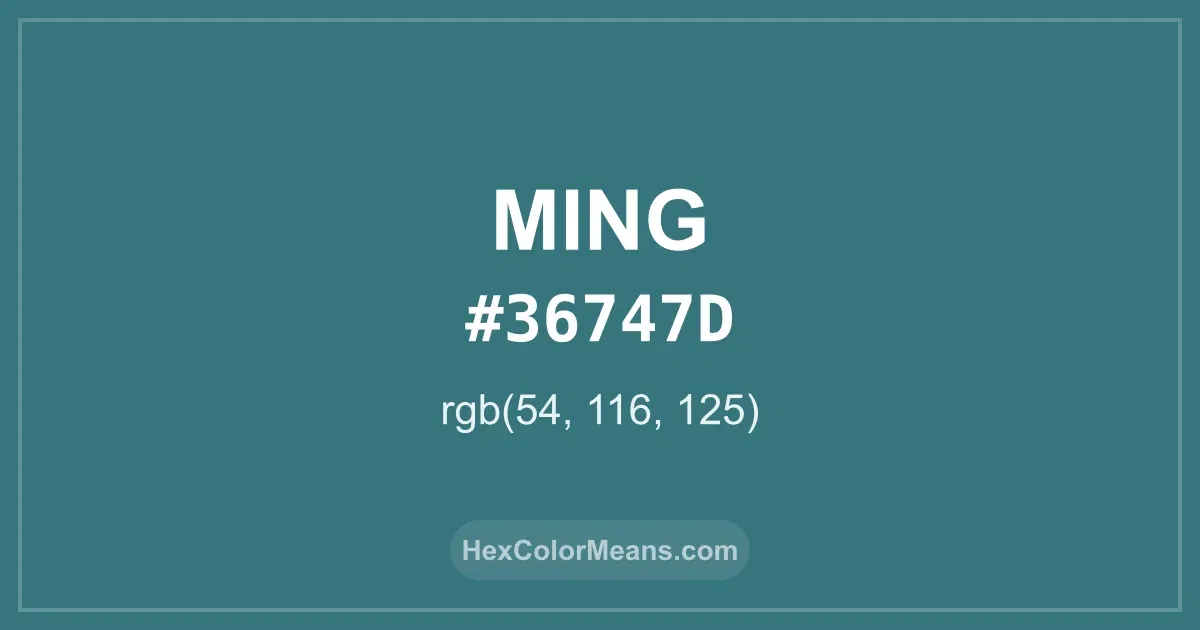
Ming (#36747D) is a medium-dark teal that blends blue and green with subtle gray undertones. It belongs to the blue-green spectrum, conveying calm, sophistication, and grounded energy. Designers often use it in corporate, maritime, and interior applications for depth and elegance. Historically, Ming (#36747D) takes its name from the Ming Dynasty in China, reflecting the classic blue-green porcelain and traditional art of the era. The color represents refinement, longevity, and stability. It communicates cultural heritage and timeless elegance in visual arts. Spiritually, Ming (#36747D) resonates with the heart and throat chakras, supporting emotional balance, clarity, and communication. Across cultures, teal tones like Ming are associated with wisdom, protection, and tranquility. It is commonly seen in textiles, ceramics, and decorative arts with symbolic significance.
Accurate conversions of Ming (#36747d) across RGB, Hex, CMYK, HSL, and Lab ensure consistent color fidelity across digital, print, and design applications.
Detailed RGB and CMYK values of Ming (#36747d) displayed in a horizontal bar provide clear reference for digital and print color accuracy.
A full range of Ming (#36747d) variations, including tints, shades, and tones, provides highlights, depth, and subtle desaturated options for UI design.
Harmonious color schemes for Ming (#36747d) created using the color wheel ensure visually balanced palettes.
Colors adjacent on the color wheel (30° apart)
Colors opposite on the color wheel (180° apart)
Three colors using one base hue and the two hues beside its opposite
Three colors evenly spaced (120° apart)
Four colors forming a rectangle on the wheel
Four colors evenly spaced (90° apart)
Four colors formed from two base hues and the colors next to their opposites
Variations of a single hue
Luminance contrast ratios for Ming (#36747d) against standard backgrounds ensure readable, accessible text following Contrast Checker and WCAG 2.1 AA/AAA standards.
Sample Text
This is how your text will look with these colors.
Simulated views of Ming (#36747d) for different color vision deficiencies help identify potential confusion using the Color Blindness Simulator.
Note: These simulations are approximations. Actual color vision deficiency varies by individual.
Sample Text
Sample Text
High-resolution seamless patterns featuring Ming (#36747d) provide ready-to-use backgrounds, wallpapers, and print designs for any project.
A collection of popular icons in Ming (#36747d) offers ready-to-use visuals for interfaces, designs, and creative projects.
Real-world mockups of Ming (#36747d) showcase its versatility across fashion, interiors, branding, and product packaging.
A curated set of tools to help apply, analyze, and manage colors effectively in your projects
Frequently asked questions about Ming (#36747d) color meaning, symbolism, and applications. Click on any question to expand detailed answers.