Red never whispers. Instead, it always shouts. This vivid color pulses with energy. It instantly commands your attention.
Think of a first blush or a warning sign. Red is truly impossible to ignore.
Importantly, it is the color of life. We see it in blood, fire, and our beating hearts.
Red is more than a simple color. It is a full experience. The meaning of red runs deep in our history and minds.
It fuels our strongest passions. This color also signals danger. Furthermore, it marks our sacred celebrations.
In this post, we will explore every layer of red. Our journey starts in ancient ochre stained caves. It continues to its modern role in branding and spirituality. Prepare to see red as a powerful force.
Key takeaways
- Red symbolizes primal energy, representing both life and danger across most cultures.
- Historically, red pigments like ochre and cochineal were among the first used by humans.
- Spiritually, red connects to the root chakra, which represents vitality and physical power.
- Psychologically, red increases heart rate and creates a feeling of urgency.
- In personality, red lovers are often action oriented, confident, and decisive.
- Around the world, red means good fortune in China but can mean mourning in South Africa.
What is the color red?
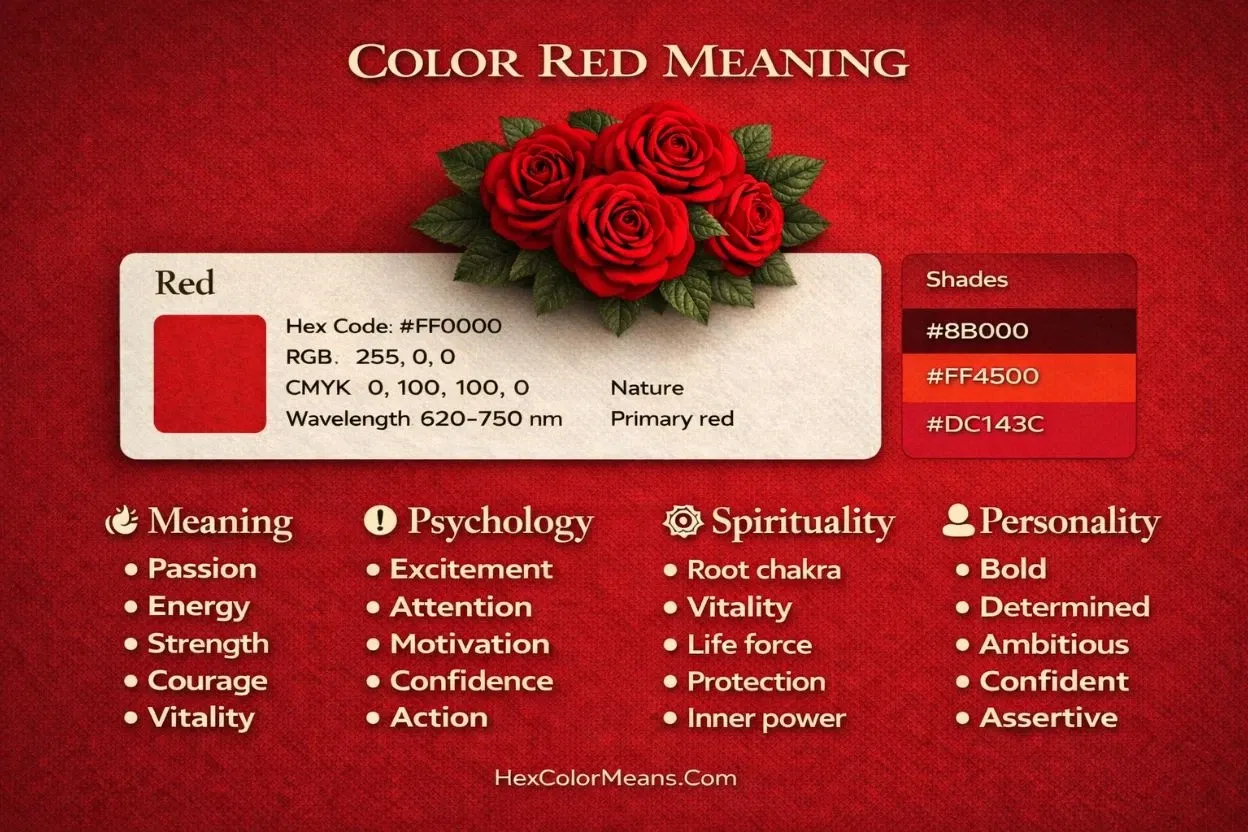
In traditional color theory, red is a primary color. It sits at the long wavelength end of the visible spectrum.
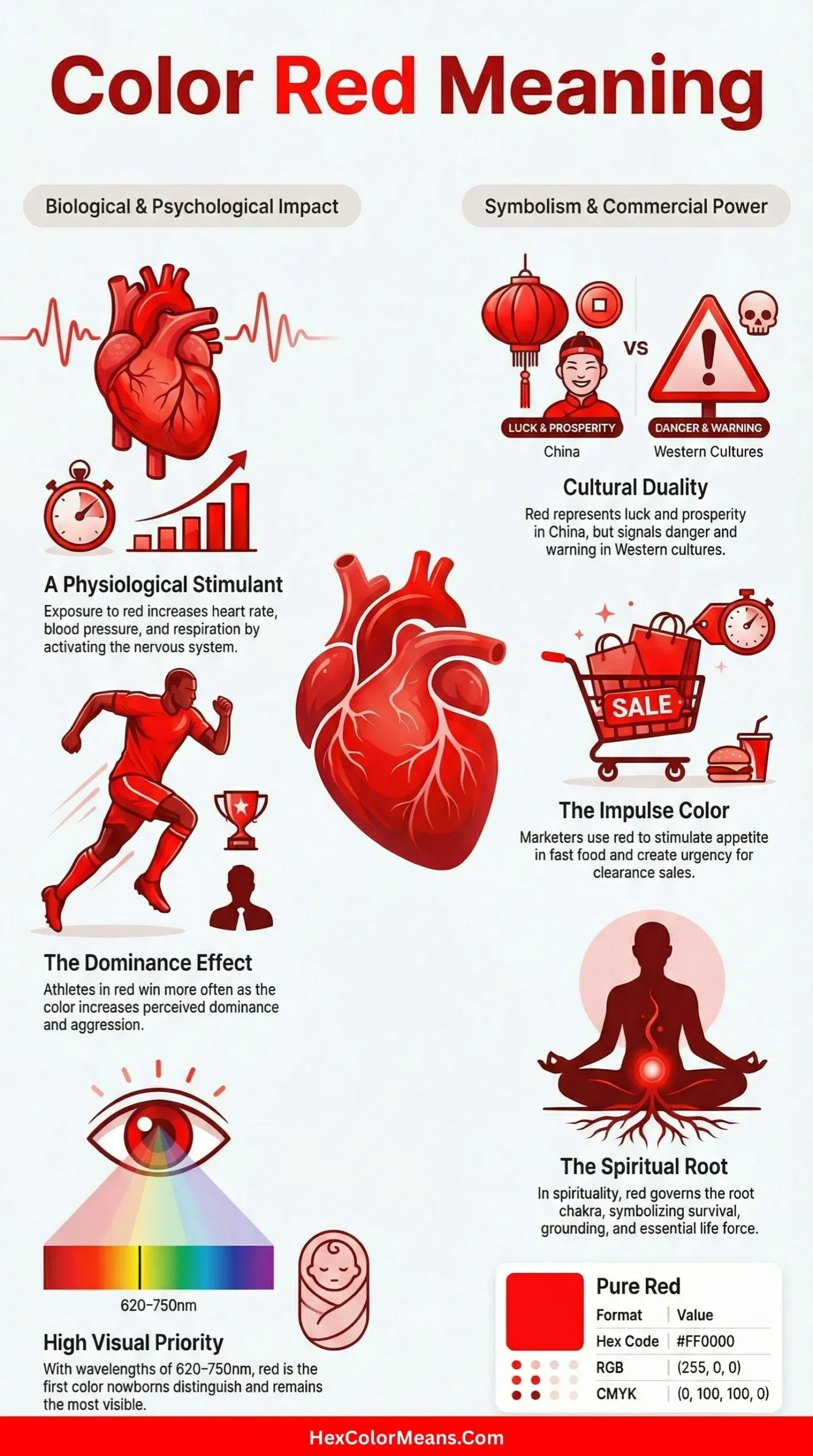
Therefore, its wavelengths range from about 620 to 750 nanometers. Because of this, red light travels well through air. Accordingly, it is the most visible color for warning signals and stop signs.
Actually, red is the first color our eyes can see in low light. Biologically, it is tied directly to survival.
We see red in blood and fire. Ripe fruit often turns red to signal it is edible. This deep link explains our powerful response to the color.
In design, red is considered warm and advancing. It refuses to fade into the background. Instead, it pushes forward and demands attention.
Designers use specific codes to reproduce red accurately:
- Hex Code: #FF0000
- RGB Code: (255, 0, 0)
- CMYK Code: (0, 100, 100, 0)
Red has many powerful shades. For example, Crimson is deep and rich, while Scarlet is bright and energetic. Vermilion is vivid and warm.
Each shade carries its own distinct feeling. Ultimately, the right red can either excite or warn.
Red appears in critical survival cues. Humans evolved to notice it immediately. We do not just see red. We react to it.
History and interesting facts
History of the color red
Red is one of humanity’s oldest pigments. Archaeologists have found red ochre in cave paintings over 40,000 years old. For example, the Lascaux caves in France show bison outlined in earthy red.
Later, ancient civilizations created refined red pigments. Egyptians used hematite in cosmetics and art. During China’s Han Dynasty, artisans made red from plants and minerals.
Romans prized a brilliant but toxic red called vermilion. During the colonial era, a dye from cochineal insects was called “red gold.”
Finally, synthetic dyes invented in the 19th century made red color stable and accessible.
Interesting facts about the color red
- Red has the longest visible wavelength, so it travels best through fog. This is why it is used for warning lights.
- Cochineal dye comes from insects. Amazingly, one pound of dye needs about 70,000 dried bugs.
- Bulls are colorblind to red. In bullfights, they react to the cape’s movement, not its color.
- Research shows red can boost physical performance. Athletes in red often win more in combat sports.
- The color red can increase appetite. Many fast food chains use it in their logos for this reason.
- Historically, red was a status symbol. In medieval Europe, only wealthy people could afford expensive red dyes.
Symbolism and representation
The color red has a rich and complex symbolism. It is often contradictory but always powerful. Throughout history and across cultures, red stands for creation and destruction. It also represents love and war, purity and sin.
1) Life and vitality
Red represents blood, which is the essence of life. Many Indigenous cultures used red ochre in burial rites. This practice symbolized rebirth.
Additionally, ancient Egyptians linked red to their sun god, Ra. They associated it with life giving power.
2) Passion and love
Red is a universal signal of deep affection and desire. You see it in Valentine’s Day roses and romantic films. This link comes from its connection to the heart.
It also relates to flushed skin during emotional arousal.
3) Danger and warning
Nature often uses red as a cautionary signal. For instance, poison dart frogs and venomous snakes display it. Toxic berries also have red markings.
Consequently, humans adopted this visual language. Stop signs, fire alarms, and error messages use red. Their goal is to trigger immediate alertness.
4) Power and authority
Red conveys dominance and high status. Roman senators wore red bordered togas. Medieval cardinals chose scarlet robes.
Even today, a “red carpet” signifies elite access. This color shows control across political and social hierarchies.
5) Revolution and change
Red flags have symbolized rebellion since the French Revolution. Later, the Bolsheviks adopted red for the workers’ uprising.
In modern protests, red clothing or banners signal solidarity. They also represent a call for radical change.
6) Sacrifice and redemption
In Christian iconography, red signifies the blood of Christ. This blood was shed for humanity’s salvation.
Martyrs are often shown in red robes. This emphasizes their ultimate sacrifice for faith.
7) Good fortune and joy
In Chinese culture, red means celebration and prosperity. It also protects against evil. Brides wear red qipaos for this reason.
During Lunar New Year, money is placed in red envelopes. Furthermore, homes are decorated in red to invite luck.
Spiritual meaning of the color red
The spiritual meaning of red focuses on energy and grounding. It is a primal force.
In Eastern traditions, red governs the root chakra. This chakra is called Muladhara and is at the base of the spine. It anchors us to the physical world. Moreover, it provides stability and a survival instinct.
A balanced root chakra fosters courage and resilience. Conversely, a blocked one may cause fear or disconnection.
In aura reading, a strong red aura shows high vitality and passion. It can also indicate leadership. However, a murky red aura might suggest anger or burnout.
Spiritual practitioners often recommend grounding exercises. For example, walking barefoot on earth can help. Meditating with red stones also harmonizes this energy.
Red candles are common in rituals for protection and strength. Burning one during meditation can ignite motivation. It may also help attract love or reinforce boundaries.
In Wiccan traditions, red corresponds to the fire element. Therefore, it is invoked in spells for courage or new beginnings.
Several crystals are linked to red. These include garnet, ruby, red jasper, and hematite. People believe garnet purifies the blood and energizes the spirit. Ruby symbolizes divine love and warrior energy.
Red jasper offers endurance during hardship. Meanwhile, hematite provides mental clarity and shields against negativity.
Unlike cooler colors like blue, red does not encourage detachment. Instead, it calls us back into our bodies. It reminds us that spirituality includes physical existence and action.
Psychological meaning of the color red
The psychology of red shows its impact on behavior and physiology. Many studies confirm it increases heart rate and blood pressure. This response is rooted in evolutionary survival.
When we see red, our brains signal a need for immediate attention.
In performance settings, red can change outcomes. Research shows athletes in red uniforms win more often in some sports. Opponents may perceive them as more dominant.
However, students exposed to red before exams tend to perform worse. This suggests red can trigger anxiety during tests.
Marketing experts leverage this duality. Red creates urgency and excitement. This is why it is used in clearance sales and fast food branding.
It also stimulates appetite by activating the hypothalamus. Therefore, it is a strategic choice for restaurants.
Still, overusing red can cause sensory overload. In workspaces, excessive red may lead to irritability. It can also cause difficulty concentrating.
Designers often balance red with neutral tones. This harnesses its energy without overwhelming people.
Color red personality traits
An attraction to the color red often signals a dynamic and action-driven personality. This preference manifests in a style of dress or decor with a clear wish to stand out. Individuals drawn to red typically possess a desire to lead and live life fully.
The following outlines common traits associated with this red personality, with research in color psychology, such as work by Andrew J. Elliot, studying these links.
1) Positive personality traits
Positive traits include confidence, energy, and courage. The red personality radiates self-assurance, often speaking clearly and maintaining strong eye contact. This confidence can inspire others to follow. Such individuals thrive on activity and bring great drive to any project. Fear tends to motivate rather than stop a red personality, leading to directly confronting challenges and volunteering for high-stakes roles.
Decisiveness and passion are further hallmarks. Quick judgments are made using instinct and experience, making this personality valuable in a crisis. Emotions are deep and vivid, with full investment in relationships or work. A fierce protectiveness and loyalty toward friends and family is also common, a trait possibly connected to red’s ancient link to survival.
2) Negative personality traits
Negative traits can involve impatience and aggression. The expectation for immediate results can cause frustration, leading to rushed choices. Under stress, natural assertiveness may turn into hostility, with interruptions or sharp criticism. Research connects the color red to increased aggression in competitive settings.
A need for control and a short temper may also surface. The drive for action can become micromanagement, with difficulty delegating tasks. There is often a low tolerance for perceived incompetence, where minor setbacks trigger strong anger. Impulsiveness is frequent, with decisions driven by emotion rather than reflection, potentially leading to rash actions.
Finally, a red personality can be competitive to a fault, viewing life as a series of contests. Even casual conversations can become battlegrounds, which ultimately strains relationships meant for cooperation.
What does the Bible say about color red?
The Bible mentions the color red over 50 times. Its meaning is deep and layered. Generally, red symbolizes blood, both real and symbolic.
This connects to major themes like sacrifice, sin, judgment, and redemption.
Modern views often link red to romance. However, the Bible uses it differently. For instance, Isaiah 1:18 states, “Though your sins are like scarlet, they shall be as white as snow.” Here, scarlet red represents sin.
Yet the verse promises cleansing and hope.
Revelation describes a woman in scarlet holding a corrupt cup. This links red to spiritual seduction.
Conversely, Hebrews 9:22 explains forgiveness requires bloodshed. Therefore, red is also tied to atonement.
Red signifies protection in other stories. During the Passover in Exodus, lamb’s blood marked doorposts. This act saved Israelite homes.
Also, Rahab hung a scarlet cord for safety in Joshua 2. Additionally, priests wore scarlet thread in the Tabernacle.
Sometimes red signals cosmic change. Revelation 6:12 describes a moon turning blood red. This portrays divine judgment.
Cultural and religious significance of the red color
Around the world, red carries diverse meanings. Its symbolism changes based on culture and history.
- China: Red is very auspicious there. It wards off evil and brings joy. During Lunar New Year, red lanterns and envelopes are everywhere. Brides often wear red for luck. Research shows red in China is linked to positive life events and prosperity.
- India: In Hinduism, red means purity and marital bliss. Brides wear red sindoor powder. The goddess Durga also embodies red’s fierce, protective energy.
- Christianity: As discussed, red means martyrdom and the Holy Spirit. Cardinals wear scarlet robes. Churches use red on Palm Sunday.
- South Africa: Some communities use red for mourning. It symbolizes ancestral blood and loss. This contrasts Western traditions where black or white is used.
- Japan: Red torii gates mark Shinto shrines. The color forms a barrier between everyday life and the sacred. Furthermore, red bibs on Jizo statues protect children.
- Native American Tribes: Tribes like the Navajo use red ochre in ceremonies. It is for healing and vision quests. Body paint in red can signal a spiritual journey.
- Islam: Green is Islam’s primary color. However, red had historical use. Ottoman sultans used red banners. Some Sufi orders wear red caps. Still, overly red clothing is sometimes seen as showy.
- Ancient Rome: Generals wore red togas after victories. This expensive dye symbolized military glory and favor from Mars, the war god.
Dream interpretations of color red
Dreams with the color red are very memorable. Red is emotionally and physically stimulating. Therefore, it often appears in dreams during strong feelings or big changes. To understand red in dreams, look at the context and your own emotions.
Seeing red blood can mean life force or emotional vulnerability. For example, bleeding without pain might mean releasing hidden feelings. Alternatively, uncontrollable bleeding could show a fear of loss.
A red door often means new opportunity or passion. Additionally, it can represent protection in some cultural traditions.
Red clothing in a dream can point to confidence or desire. Wearing red may mean you are ready to take charge. Seeing another person in red might highlight their power over you.
Red animals, like a bird or fox, often carry warnings. A red snake could mean hidden danger or change, based on your culture.
Fire or red skies usually signal big change or purification. Threatening fire may reflect anxiety about losing control. Conversely, warm fire could symbolize spiritual renewal.
Recurring red dreams are common during stress. Psychologists suggest red acts as an internal alarm. It urges you to pay attention to ignored needs or conflicts.
How to use the color red
1. Color red in business
Red commands attention. It also drives action. Businesses use red to create urgency. They highlight key offers with it.
Additionally, companies use red to seem bold and energetic. For example, YouTube’s red play button signals immediacy. Meanwhile, Netflix’s red logo conveys drama.
However, you must use red strategically. Studies show overuse can overwhelm customers. It may even trigger anxiety.
Therefore, follow best practices. Use red for call to action buttons like “Buy Now.” Apply it to limited time offers. Red works well as a brand accent.
Conversely, avoid dominant red backgrounds in some fields. Professional services like law need trust and calm.
2. Color red in branding and marketing
Red is a powerhouse in branding due to color psychology. Brands like Coca Cola and Target use it. They evoke excitement and confidence.
In fact, Coca Cola has used red since the 1890s. This consistency makes it a global symbol of joy.
Red works best for youth and energy brands. Yet, it underperforms in luxury markets. Sustainability focused brands often avoid it.
Pairing red with white increases contrast. Using it with black enhances memorability.
3. Color red in interior design
Red energizes interior spaces. But it also demands balance. An accent wall in a dining room stimulates conversation.
Research suggests it can even increase appetite. Still, too much red in bedrooms causes restlessness.
Designers often choose deep reds like burgundy for studies. These colors convey sophistication.
Pair red with neutrals like beige to soften it. Combining it with gold adds warmth and luxury.
4. Red color in cinema
Filmmakers use red to signal passion or danger. In The Sixth Sense, red marks spiritual connections.
Schindler’s List features a girl in a red coat. This symbolizes innocence in a black and white film.
Director Wes Anderson uses red for whimsical worlds. Stanley Kubrick used it to evoke dread.
Ultimately, red lighting or costumes can foreshadow pivotal moments.
5. Red color In humans
Biologically, red is a powerful human signal. Blushing shows embarrassment or attraction. Flushed skin can mean fever or anger.
Even rare red eyes in albinism carry meaning. Socially, red influences perception.
Studies show women wearing red are seen as more attractive. Men in red shirts are rated as more dominant. This proves red affects our unconscious judgments.
6. Red color in makeup
Red lipstick is an iconic makeup statement. It signals authority and sensuality.
Modern ranges offer matte crimson or glossy cherry shades. Furthermore, red blush adds warmth by mimicking circulation.
Red nail polish conveys confidence. Many choose it for job interviews as a subtle power move.
7. Red food
In nature, red foods are rich in antioxidants. Tomatoes, strawberries, and red peppers offer nutritional value.
Culturally, red foods mark celebrations. Examples include red bean paste in Japanese mochi. Another is pomegranate seeds in Middle Eastern dishes.
Interestingly, artificial red dye is common in candy. Research finds it enhances perceived sweetness. This shows how color shapes our taste expectations.
8. Red in quotes and idioms
Our language is full of red metaphors. This shows how deeply the color shapes our thinking. Common idioms include several vivid examples.
For instance, “seeing red” means losing control from anger. “Red tape” describes bureaucratic delays. This term actually originated from 16th-century Spanish legal documents. Those documents were bound with red ribbon.
Another phrase, “paint the town red,” means to celebrate wildly. Meanwhile, “red-handed” means caught doing something wrong. Historically, it referred to blood on a criminal’s hands.
Finally, “in the red” means facing a financial loss. This comes from old accounting ledgers using red ink for deficits.
Famous quotes also highlight red’s intensity. Actress Ruth Bader Ginsburg once explained her judicial collars. She said, “I wore red because I wanted to feel powerful.”
Additionally, artist Henri Matisse made a declaration about the color. He stated, “When I put down a red, it’s not just a red—it’s a force.”
These expressions prove red is more than just aesthetics. It lives in our speech and shapes how we describe emotion, justice, and risk.
9. Red in art and architecture
From prehistoric caves to modern galleries, red has shaped art. Michelangelo used red chalk for dynamic figure studies. Mark Rothko’s red paintings evoke spiritual depth. He achieved this through layered pigment.
In architecture, red brick once defined industrial cities. Conversely, red lacquered temples in China and Japan radiate sacred energy.
Consider the Red Room at the White House. It is adorned in crimson silk and symbolizes diplomatic warmth. In contrast, artist Rachel Whiteread used red differently.
Her work Untitled (Room 101) is a concrete cast of a fictional torture chamber. It uses red lighting to evoke psychological terror. So, red in art is rarely just decorative. It demands emotional engagement from the viewer.
10. Songs with red in the title
Music often uses red to convey strong feelings. These feelings include passion, pain, or rebellion. Taylor Swift’s album Red explores love’s volatile spectrum.
Chris Isaak’s “Wicked Game” features smoldering red visuals. The lyrics speak of a heart breaking world.
Other notable songs use the color as a key theme:
“Red Red Wine” by UB40 is about longing and intoxication.
“Ruby Tuesday” by The Rolling Stones describes fleeting beauty.
“Scarlet Begonias” by Grateful Dead evokes sensuality and mystery.
“Red Light” by David Nail conveys warning and hesitation.
Therefore, these songs use red as an emotional shorthand. This makes the feeling immediate and unforgettable for the listener.
11. Cities with color names: Red
Few cities are literally named “Red.” However, many have red related names from geography or history. For example, Redding, California was named for a railroad executive. Nonetheless, it is surrounded by red rock canyons.
Red Bank, New Jersey likely gets its name from red clay soil. This soil is found along the Navesink River.
Meanwhile, Red Deer, Alberta is named for the reddish brown deer native there. Scarborough, England comes from Old Norse. It means “fortress on the red cliff.”
Furthermore, some places are visually dominated by red. Red Square in Moscow is a key example. Its name comes from an old Russian word for “beautiful,” not the color. Yet its red buildings strengthen its cultural association.
12. The color red in the garden
In gardens, red creates strong visual points. It also attracts pollinators. Flowers like roses, tulips, and poppies deliver bold statements. Additionally, red leaved plants add dramatic contrast. Japanese maples and coleus are popular choices.
Garden designers usually use red sparingly. Research shows it can overwhelm a space if overplanted. When placed near cool colors like blue, red pops visually.
Symbolically, red blooms often represent deep love, as with roses. Alternatively, poppies signify remembrance for fallen soldiers.
Interestingly, birds like hummingbirds are drawn to red flowers. They have evolved to link the color with nectar rich blooms.
This natural synergy highlights red’s role beyond human culture. It is also vital for ecological communication.
Final thoughts
The color red has a complex meaning. It is full of opposing ideas. For instance, it can represent healing but also harm. It can attract attention yet also repel. This color empowers people but can also overwhelm them.
Ancient humans used red ochre in cave paintings. Now, it powers the “Like” button on your screen. Research shows red is the most intense color to the human eye. It truly remains our most urgent color.
Red’s power comes from its immediacy. It does not request attention. Instead, it simply takes it. However, this intensity is very useful when applied purposefully.
Consider choosing a brand logo or painting a room. You might interpret a dream or select a lipstick. Knowing red’s layers helps you use its energy wisely. Importantly, you avoid being consumed by it.
This color reminds us life is vivid and fleeting. Life is also worth feeling completely. Red symbolizes first breaths and final words. It appears on protest signs and under wedding veils.
It is the color of dying embers and living arteries. To understand red is to understand ourselves. We are not just passive observers. We are beings who bleed, burn, and rise again.